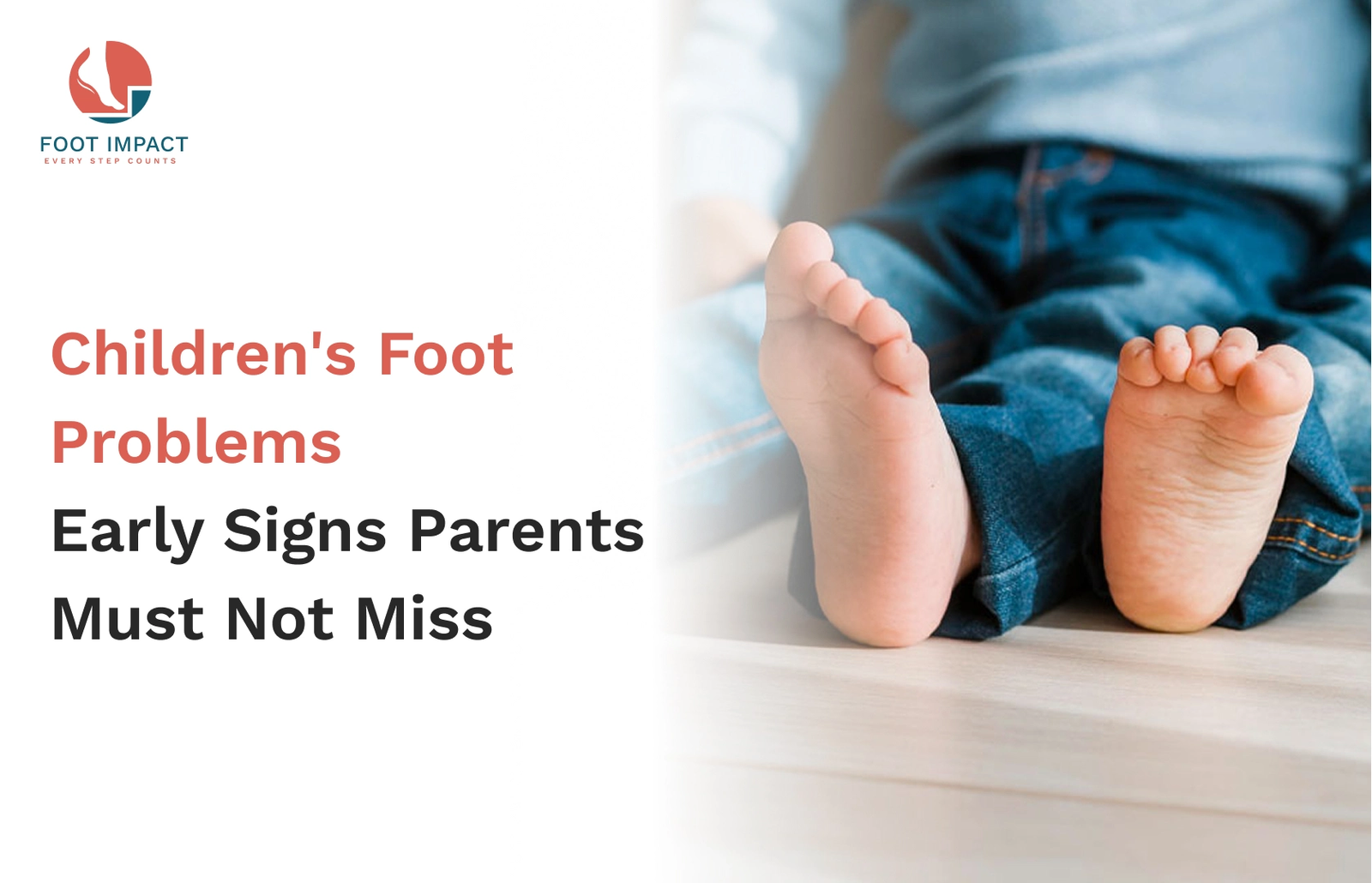
Children's Foot Problems: Early Signs Parents Must Not Miss
Most parents keep a close eye on their child's first steps, first words, and early milestones. But foot development? That tends to fly under the radar — until something clearly looks wrong. The reality is that many of the most impactful children flat feet treatment Mumbai cases we see at Foot Impact begin with a parent noticing something subtle: a child who trips more than other kids, who refuses to walk after school, or whose feet seem to point inward or outward in a way that just doesn't look right.
Children's feet are not simply smaller versions of adult feet. They're actively developing — bones are still forming, arches are still establishing themselves, and gait patterns are still maturing. This developmental window is actually an enormous opportunity. Problems caught early, during the years when the foot is still growing and malleable, respond far better to intervention than the same conditions left untreated into adulthood.
This guide covers the foot conditions parents most commonly miss, how to spot early warning signs, and what modern podiatric care can do to support your child's long-term mobility and comfort.
Are Children's Foot Problems Normal or a Cause for Concern?
This is probably the most common question paediatric podiatrists hear — and the honest answer is: it depends. Some conditions that look alarming are completely normal at certain developmental stages. Others that look mild are early signs of something that will worsen without care. Telling the two apart requires knowing what's typical at each age.
For example, most babies are born with flat-looking feet. That's expected — the arch develops gradually during the first decade of life. Similarly, mild inward turning of the feet (in-toeing) is common and often resolves on its own by age four or five. However, when these features persist beyond the expected developmental window, remain asymmetrical, cause pain, or affect how a child walks or plays, they stop being variations of normal and become clinical concerns.
The key principle is this: a child who avoids physical activity, complains of leg or foot pain regularly, trips frequently, or is noticeably slower than peers at physical tasks deserves a proper foot assessment. These are not quirks to be outgrown — they are signals worth taking seriously.
Flat Feet in Children: When Does It Actually Need Treatment?
Paediatric flat feet — medically termed pes planus — is the most common reason parents seek children flat feet treatment in Mumbai. And yet it's also the most frequently dismissed. Many parents are told "don't worry, they'll grow out of it" — advice that's sometimes correct, but not always.
The Difference Between Flexible and Rigid Flat Feet
There are two main types. Flexible flat feet are by far the more common form: the arch disappears when the child stands but reappears when they sit or stand on their tiptoes. Rigid flat feet, where the arch is absent even when the foot is unloaded, are rarer and require more urgent evaluation — they often have a structural or bony cause.
For flexible flat feet, the question isn't whether the arch is visible — it's whether the condition is causing problems. Signs that your child's flat feet warrant professional attention include:
Complaints of foot, arch, or calf pain after walking or playing
Reluctance to participate in sports or physical activity
Walking with feet turned outward to compensate for arch collapse
Visible wear on the inner edges of shoes, wearing out faster than expected
Difficulty finding comfortable footwear
Knee or lower back pain that has no other explanation
In these situations — or when the flat feet persist beyond age six without any arch development — a podiatric assessment is warranted. Early intervention with supportive orthotics, targeted exercises, and appropriate footwear can prevent the compensatory issues that tend to develop when flat feet go unmanaged.
Toe Walking in Children: Normal Phase or Red Flag?
Watching a toddler walk on their tiptoes is charming — and in children under the age of three, it's often just a phase. Many toddlers experiment with toe walking as they develop balance and coordination. The concern arises when it continues beyond three years of age, especially if it's persistent (rather than occasional) and particularly if it's bilateral (both feet).
What Causes Persistent Toe Walking?
Child toe walking causes range from benign to clinically significant. Some of the more common explanations include:
Idiopathic toe walking — habitual, with no identifiable cause, but may indicate shortened Achilles tendons over time
Tight calf muscles or Achilles tendon — a physical restriction that makes full heel contact uncomfortable
Sensory processing differences — some children with sensory sensitivities prefer toe contact for tactile reasons
Neurological conditions — including cerebral palsy and autism spectrum conditions, where toe walking is sometimes an early observable feature
What makes toe walking worth taking seriously is that continued tip-toe gait shortens the Achilles tendon and calf muscles, alters gait mechanics, and can eventually affect posture and balance. A podiatrist — working alongside physiotherapists and, if appropriate, a paediatrician — can assess whether the cause is mechanical, habitual, or something that needs broader investigation.
In-Toeing and Out-Toeing: When Should Parents Seek Help?
In-toeing ("pigeon-toed" walking, where the feet point inward) and out-toeing (feet pointing outward) are both common in young children. Most cases resolve without treatment. But again, the developmental timeline matters, as does whether the condition affects function.
In-Toeing
In-toeing in children under five is usually caused by one of three things: metatarsus adductus (inward curving of the forefoot), internal tibial torsion (inward rotation of the shin bone), or femoral anteversion (inward rotation at the hip). All three typically improve with normal growth and activity. However, if in-toeing is severe, causes the child to trip repeatedly, remains unchanged past age eight, or is present on one side only, it should be evaluated. In-toeing treatment in children India may involve gait retraining, specific stretching exercises, orthotic support, or in rare cases, specialist referral.
Out-Toeing
Out-toeing is somewhat less common than in-toeing and tends to be associated with flat feet — the foot splays outward as a consequence of arch collapse. When flat feet are the driver, treating the flat feet (with orthotics and footwear guidance) typically also improves the out-toeing pattern. Out-toeing that is painful, worsening, or asymmetrical always deserves professional evaluation.
How Footwear Affects Your Child's Foot Development
Here's something that surprises many parents: children don't actually need shoes for foot development. Barefoot time — particularly on natural, uneven surfaces — actively strengthens the foot muscles, develops proprioception, and supports healthy arch formation. The foot's intrinsic muscles, which hold the arch up from within, develop through contact with varied terrain.
That said, when shoes are necessary — for protection, school, and outdoor activity — the choice matters enormously. Poorly fitting shoes, overly rigid soles, or footwear without adequate support can actively interfere with natural development. When choosing shoes for a child with flat feet or any structural concern, the most important features are:
A firm heel counter (the back cup of the shoe) for rearfoot stability
Flexible forefoot that bends at the ball of the foot, not the midfoot
Adequate toe box width to allow natural toe splay
A low, stable heel — avoid built-up heels in everyday shoes
Accurate sizing — children's feet grow quickly and should be measured regularly
For children with flat feet, overpronation, or other structural concerns, corrective shoes for children in Mumbai — combined with professionally prescribed orthotics — offer significantly better outcomes than standard footwear alone. Your podiatrist can advise on appropriate brands and features based on your child's specific foot type. For tailored guidance, learn more about custom orthotics for children at Foot Impact.
The Role of Corrective Orthotics in Growing Feet
There's a common misconception that orthotics are only for adults with chronic foot conditions. In fact, childhood is often the most impactful time to introduce orthotic support — precisely because the foot is still growing and highly responsive to corrective input.
Custom orthotics for children work by guiding the foot into a more anatomically aligned position during weight-bearing activity. For flat feet, they support the medial arch and prevent excessive pronation. For children with gait abnormalities, they can influence the rotational mechanics of the whole lower limb. Unlike rigid adult orthotics, children's orthotics are designed to work with the growing foot — not restrict it.
It's worth emphasising that not every child with flat feet needs orthotics. The decision depends on the severity of the structural finding, whether symptoms are present, and the child's age and developmental stage. A blanket prescription of orthotics for all flat-footed children is not evidence-based. What is evidence-based is a proper clinical assessment to determine whether intervention is appropriate, and if so, what form it should take.
If you're exploring children flat feet treatment in Mumbai and wondering whether orthotics are the right step, our podiatry team at Foot Impact provides thorough assessments before any treatment recommendation is made.
At What Age Should a Child First See a Podiatrist?
There's no single universal answer — but there are good guidelines. Here's a simple framework for parents:
It's also worth knowing that a podiatric assessment for a child is a low-risk, non-invasive process. The podiatrist observes the child walking, assesses foot structure and flexibility, and reviews footwear. Even if no intervention is needed, you leave with clarity — and that peace of mind has real value.
For a full picture of how your child moves and loads their feet, a paediatric gait analysis at Foot Impact provides objective, visual data that helps guide the most appropriate next steps.
Warning Signs That Should Prompt an Urgent Appointment
While many paediatric foot concerns can be monitored over time, some warrant prompt professional attention. Contact a kids foot pain podiatrist sooner rather than later if you notice:
Limping that appears suddenly or persists for more than a few days
Swelling, redness, or warmth around a joint without a clear injury
One foot or leg that looks or functions noticeably differently from the other (asymmetry)
A child who was previously walking normally begins toe walking
Foot pain that wakes the child at night (this is rarely growing pains — those typically affect the thighs and calves)
Ingrown toenails that are recurring, infected, or extremely painful
Warts (verrucae) that are spreading or affecting the child's ability to walk comfortably
Many parents in Mumbai attribute children's foot pain to growing pains and wait it out. While growing pains are real, they follow a specific pattern — typically occurring in the muscles of the legs at night, not in the joints or on the soles of the feet. Joint pain, plantar pain, or pain that occurs during activity should always be taken seriously.
📷 [Image: Podiatrist conducting a gait analysis on a child in a clinical setting] ALT TEXT: "Kids foot pain podiatrist paediatric gait analysis Mumbai"
Our Approach to Paediatric Foot Care at Foot Impact, Mumbai
At Foot Impact, we understand that bringing a child to a clinical appointment requires trust — in both the process and the practitioner. Our paediatric consultations are designed to be relaxed, age-appropriate, and thorough. We take the time to explain findings to parents clearly, discuss all options openly, and never recommend intervention unless there is a genuine clinical basis for it.
Our podiatrists are experienced in assessing children across all developmental stages, from toddlers just starting to walk to pre-teens entering the growth spurt years. We use digital pressure mapping, video gait analysis, and hands-on clinical assessment to build a complete picture — and we work collaboratively with paediatricians, physiotherapists, and orthopaedic specialists when broader care is needed.
Frequently Asked Questions
At what age do children's arches normally develop?
Most children begin developing a visible arch between the ages of three and six. By age eight to ten, the arch is typically established. If no arch has appeared by age six, or if the foot remains painful or functionally limited, a podiatric assessment is recommended.
Should I be worried about my child's flat feet?
Not necessarily. Many children have flexible flat feet that cause no problems and improve with age. However, if your child complains of foot or leg pain, avoids physical activity, wears out shoes unusually fast, or has flat feet that are rigid (arch absent even when sitting), a professional assessment is a sensible step.
What causes toe walking in children?
Child toe walking causes include habitual patterns, tight Achilles tendons, sensory processing differences, and in some cases neurological conditions such as cerebral palsy or autism spectrum disorder. Persistent toe walking beyond age three should be evaluated by a podiatrist or paediatrician.
Are corrective shoes enough for flat feet in children, or are orthotics needed?
Appropriate footwear is an important foundation, but for moderate to significant flat feet causing symptoms, custom orthotics provide a level of support and correction that standard footwear cannot. A podiatrist can assess whether orthotics are clinically indicated for your child.
Where can I find a paediatric podiatrist for flat feet treatment in Mumbai?
Foot Impact in Mumbai offers specialist paediatric foot assessments, including gait analysis, pressure mapping, and custom orthotics. Our team evaluates children of all ages and provides evidence-based recommendations for flat feet, toe walking, in-toeing, and other developmental foot concerns.
Do children's orthotics restrict foot development?
Well-designed paediatric orthotics are not restrictive — they guide the foot into better alignment while allowing natural movement. The goal is to support healthy development, not to immobilise the foot. Your podiatrist will select or prescribe orthotics appropriate for your child's age and specific condition.
Is in-toeing always something that needs treatment?
Not always. Mild in-toeing in children under five often resolves naturally. In-toeing that is severe, one-sided, persistent beyond age eight, or causing the child to trip and fall frequently should be assessed. Treatment options — when needed — may include exercises, gait retraining, or orthotics.
Conclusion: Early Attention Pays Dividends for Life
Children's feet are extraordinary structures — capable of remarkable adaptation, but also genuinely vulnerable during the years when they're still forming. The window between birth and early adolescence is when intervention is most effective and least invasive. A foot problem corrected at age seven is far simpler to address than the same structural issue left untreated until adulthood.
Children flat feet treatment in Mumbai, paediatric gait assessment, corrective orthotics, and footwear guidance — these aren't just clinical services. They're investments in how comfortably and confidently your child moves through the world for the rest of their life.
If you've noticed something about your child's feet or gait that's given you pause — even something you're not sure is significant — the best thing you can do is get it assessed. The appointment may tell you there's nothing to worry about. Or it may catch something early enough to make a real difference.