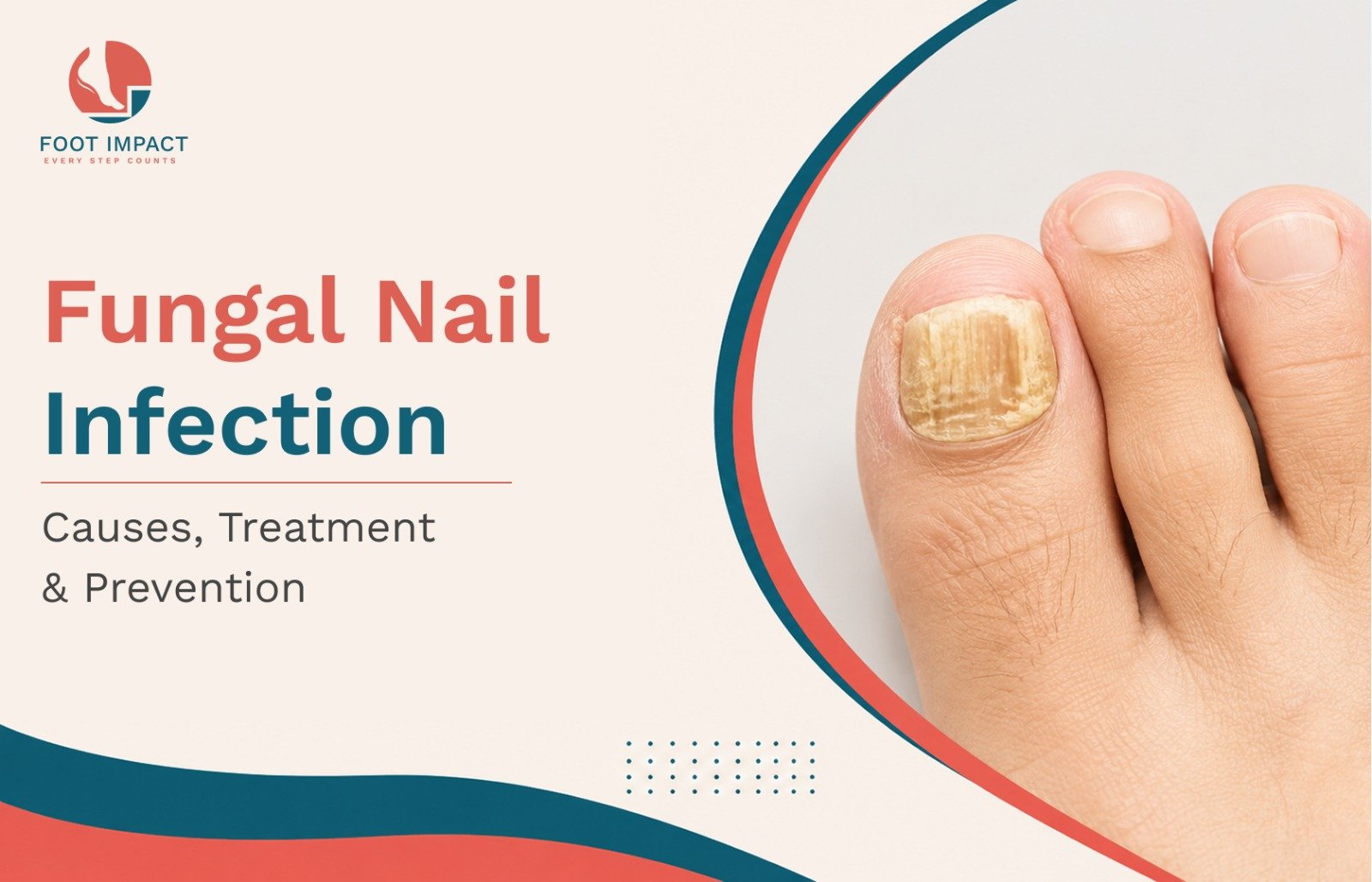
Fungal Nail Infection: Causes, Treatment, and How to Stop It Coming Back
It usually starts small. A white spot near the nail tip. A yellowish tinge you assume is nail polish staining. A nail that feels a bit thicker than before.
Most people ignore these signs. It doesn't hurt, so it doesn't feel urgent.
That's the problem. Fungal nail infections move slowly. By the time a nail looks thick, crumbly, and discoloured, the infection is usually well established — and has often spread to nearby nails. At that point, a pharmacy cream rarely does the job. Months pass. The nail gets worse. Frustration builds.
Fungal nail infection treatment in Mumbai is one of the most common reasons people visit Foot Impact. It's also one of the most mismanaged conditions, because there's a big gap between what a pharmacy offers and what a podiatrist can do.
This guide covers:
- Why fungal nail infections develop
- How to tell mild from serious cases
- Why DIY treatments often fail
- What real, professional treatment looks like
What Causes Fungal Nail Infections?
The medical name is onychomycosis. It's usually caused by fungi called dermatophytes — most often Trichophyton rubrum. Sometimes yeasts (like Candida) or other moulds are the cause instead. This matters, because different antifungals target different organisms.
These fungi live in warm, damp places. You can pick them up from:
- Contaminated surfaces
- Infected people
- Your own skin infection (athlete's foot often spreads to the nails)
Who's at Higher Risk?
Age. Nail growth slows as we age, circulation to the nail bed drops, and small injuries build up over time — all of which make it easier for fungus to take hold. Infections are far more common after age 60.
Diabetes. This raises risk sharply. Weaker immune response, poor circulation, and a warm, moist foot environment all make infections easier to catch and harder to fight. In diabetic patients, nail fungus isn't just cosmetic — it can be a gateway to bacterial infections and diabetic foot complications. Our Diabetic Foot Pain Treatment service includes regular nail checks for exactly this reason.
Excess sweating (hyperhidrosis). Keeps feet damp for long periods — ideal fungal conditions.
Weakened immunity. From medication, illness, or other conditions — makes it harder for the body to stop fungal growth.
Lifestyle and occupation. Regular use of gyms, pools, or shared changing rooms raises exposure. Runners are also at higher risk, since repeated toenail trauma creates easy entry points for fungus.
What Onychomycosis Looks Like: Early to Advanced
Knowing where your nail sits on this scale helps decide how urgent treatment is.
Early stage:
- A white or yellow spot at the tip or side of the nail
- Slight thickening
- Rough surface, less shine
Moderate stage:
- Yellow, brown, or white discolouration covering most of the nail
- Noticeably thicker — hard to trim with regular clippers
- Nail starting to lift from the nail bed (called onycholysis)
- Debris building up under the nail
Advanced stage:
- Nail is badly thickened, crumbly, and misshapen
- Deep yellow, brown, or grey colour — sometimes greenish if bacteria are also involved
- Nail partly or fully detached
- Noticeable odour
- Nearby nails and skin often affected too
One important note: a thick, yellow, lifted nail isn't always fungal. Psoriasis, nail trauma, and lichen planus can look similar. This is why a proper exam — sometimes including a lab test on a nail clipping — matters before starting treatment. Using antifungals on a non-fungal nail for six months won't help, and just wastes time.
Why Pharmacy Treatments Often Don't Work
This is the question we hear most: "I've used the antifungal lacquer for months and nothing's changed. Why?"
It comes down to nail biology. The nail plate is dense, compact keratin. Topical antifungals struggle to penetrate it — especially in thick, damaged nails. For mild, early infections, a good topical product (like amorolfine or ciclopirox) used consistently for months can work. Beyond that stage, topical treatment alone often fails.
A few reasons why:
- Inconsistent use. Amorolfine needs weekly application, ciclopirox daily — for 6 to 12 months. Few people keep this up.
- No nail prep. Topical antifungals work much better once the nail is thinned first. Skip that step, and the medicine has far more keratin to get through.
- Reinfection from shoes. If your shoes are still carrying fungus, you can get reinfected even mid-treatment.
- Wrong product for the fungus. If Candida or a mould — not a dermatophyte — caused the infection, common OTC products may not work well against it.
Pedicures, Public Pools, and Nail Fungus
Nail infections after pedicures are more common than people realise — and worth knowing about, especially as nail salons have grown fast across Mumbai.
Fungus spreads through direct contact: unsterilised tools, shared foot baths, and dirty surfaces. If a salon doesn't properly sterilise instruments (autoclaving, not just wiping down), reuses foot baths without disinfecting them, or skips single-use materials, it's a real transmission risk.
The tricky part: symptoms don't show up right away. It can take weeks or months, so most people never connect the infection back to the salon visit. That means the risk often goes unnoticed — and keeps affecting other clients too.
Public pools, shared changing rooms, gym showers, and yoga studios carry similar risks. Warm, wet surfaces around these areas are known fungal hotspots. That's why wearing sandals or slippers in these spaces isn't just a preference — it's real protection.
According to the American Academy of Dermatology (AAD), wearing sandals in shared wet areas and not sharing nail tools are among the best-supported ways to prevent nail fungus.
How Podiatrists Diagnose and Treat Fungal Nails
Getting fungal nail infection treatment in Mumbai through a podiatry clinic is far more effective than self-treatment, for two reasons: better diagnosis, and more treatment options.
Step 1: Clinical Assessment
We examine the nail and, if needed, take a clipping sample for lab testing. This identifies the exact cause — dermatophyte, Candida, or mould — sometimes using a direct microscope test (KOH prep).
Why this matters: the right antifungal depends on the organism. Treating without this step is a common reason treatment fails.
We also check how far the infection has spread, how many nails are affected, whether there's a skin infection too, and whether risk factors like diabetes need extra care.
Step 2: Nail Debridement
This is one of the biggest advantages of professional care over pharmacy-only treatment. Debridement means mechanically thinning and reducing the infected nail using clinical tools. It:
- Removes most of the infected material
- Thins the nail so antifungal treatment can actually penetrate
- Lowers the fungal load
- Relieves pressure discomfort from thickened nails
This isn't something to try at home with regular clippers — attempting it yourself on a thick, damaged nail risks injury and infection.
Our Ingrown and Fungal Toenail service covers both the clinical treatment and the ongoing care that keeps the infection from coming back.
Step 3: Prescription-Strength Topical Treatment
After debridement, we can prescribe stronger antifungal formulas than what's sold over the counter — including amorolfine 5% lacquer, ciclopirox, and newer delivery systems built for better nail penetration.
Combining debridement with the right prescription treatment produces much better results than OTC products used alone.
Step 4: Oral Antifungal Therapy (When Needed)
For moderate to severe cases — especially multiple nails, failed topical treatment, or deep infection — oral antifungals are the most effective option. Terbinafine and itraconazole are the most common, usually prescribed for 6 to 12 weeks.
These are prescribed by a physician, not a podiatrist — but we identify when it's needed and refer you appropriately. Oral antifungals sometimes require liver function monitoring and a check for drug interactions, which is why this isn't a decision to make at the pharmacy counter.
According to the British National Formulary (BNF), terbinafine cures roughly 70–80% of toenail fungal infections when taken for the right duration — well above topical-only results for established infections.
Step 5: Laser Treatment (For Resistant Cases)
Fungal nail laser treatment in Mumbai is a newer option, growing in evidence. It uses targeted laser energy to damage fungus inside the nail without harming surrounding tissue. It's mainly used when patients can't take oral antifungals, or when topical treatment hasn't been enough.
Laser usually works alongside antifungal treatment, not instead of it. Multiple sessions are typically needed. The Journal of the American Podiatric Medical Association (JAPMA) has published studies supporting laser as part of a combined treatment approach.
Preventing Reinfection: The Step Most People Skip
Clearing an infection is only half the job. Stopping it from coming back is the other half — and it's where most people fall short.
Fungus can survive in your environment for a long time. Shoes worn during the infection are often still carrying fungus, and going back to them after treatment can restart the whole cycle.
A simple reinfection-prevention routine:
- Treat shoes with antifungal spray or powder — both during and after treatment
- Replace old trainers or closed shoes worn during the infection
- Always wear sandals or slippers in shared wet areas — no exceptions
- Dry your feet fully after washing, including between every toe, every day
- Use antifungal powder between toes if you're prone to athlete's foot
- Never share nail clippers, files, or tools
- Check your nails monthly and act early if anything changes
Recurrence is common without these steps — studies consistently show that treated infections often return in patients who skip prevention.
If your infection started during monsoon season, our Monsoon Foot Care guide covers the broader hygiene habits that help prevent fungal issues.
Frequently Asked Questions
How long does treatment take? It depends on severity and method. Toenails grow slowly — about 1–2mm a month — so a full nail replacement takes 9–12 months. Even if the infection clears in weeks, the nail only looks fully better as new, healthy nail grows in. Expect 6–9 months for real visible improvement, and about a year for full regrowth. This is normal, not a sign of failure.
Can I get a fungal infection from a pedicure salon? Yes — this is a known transmission route. Poorly sterilised tools, shared foot baths, and dirty surfaces can all spread fungus. Ask salons how they sterilise instruments (autoclaving, not just wiping), or bring your own tools. An infection appearing weeks after a salon visit may well have started there.
Is a thick yellow toenail always fungal? No. Psoriasis, nail trauma (common in runners), lichen planus, and some other conditions can look similar. That's why a proper exam — and sometimes a lab test — is worth doing before starting antifungal treatment. Treating a non-fungal nail with antifungals for months won't help.
Can it spread to family members? Yes, though it spreads more slowly at home than in gyms or pools. Shared bathrooms, towels, walking barefoot on bathroom floors, and shared nail tools can all pass it along. Using your own towel, wearing slippers, and disinfecting the shower floor during treatment reduces this risk.
Do I need a podiatrist, or can I treat it myself? For very mild, early cases in healthy people, a consistent OTC routine may be enough. For anything more advanced — diabetic patients, infections that haven't responded to treatment, or multiple affected nails — professional care adds real value: correct diagnosis, debridement, prescription treatment, and monitoring. Professional treatment is usually cheaper overall than months of ineffective self-treatment followed by a clinic visit anyway.
The Bottom Line
Fungal nail infections are treatable — but only with the right approach. That means patience, treatment matched to the specific fungus and severity, and a prevention plan that continues after treatment ends.
Nails treated without debridement, with weak antifungals, for too short a time, or without addressing the source almost always relapse. That's usually why people feel let down before they ever reach a podiatry clinic — not because the infection can't be treated, but because the approach didn't match the problem.
With the right diagnosis, proper nail reduction, the right antifungal therapy, and a solid prevention routine, most fungal nail infections can be cleared for good.
If you've got a nail that keeps getting worse despite over-the-counter treatment, book an appointment at Foot Impact for a full assessment and treatment plan. Or start with an online consultation to talk through your case with a podiatrist first.