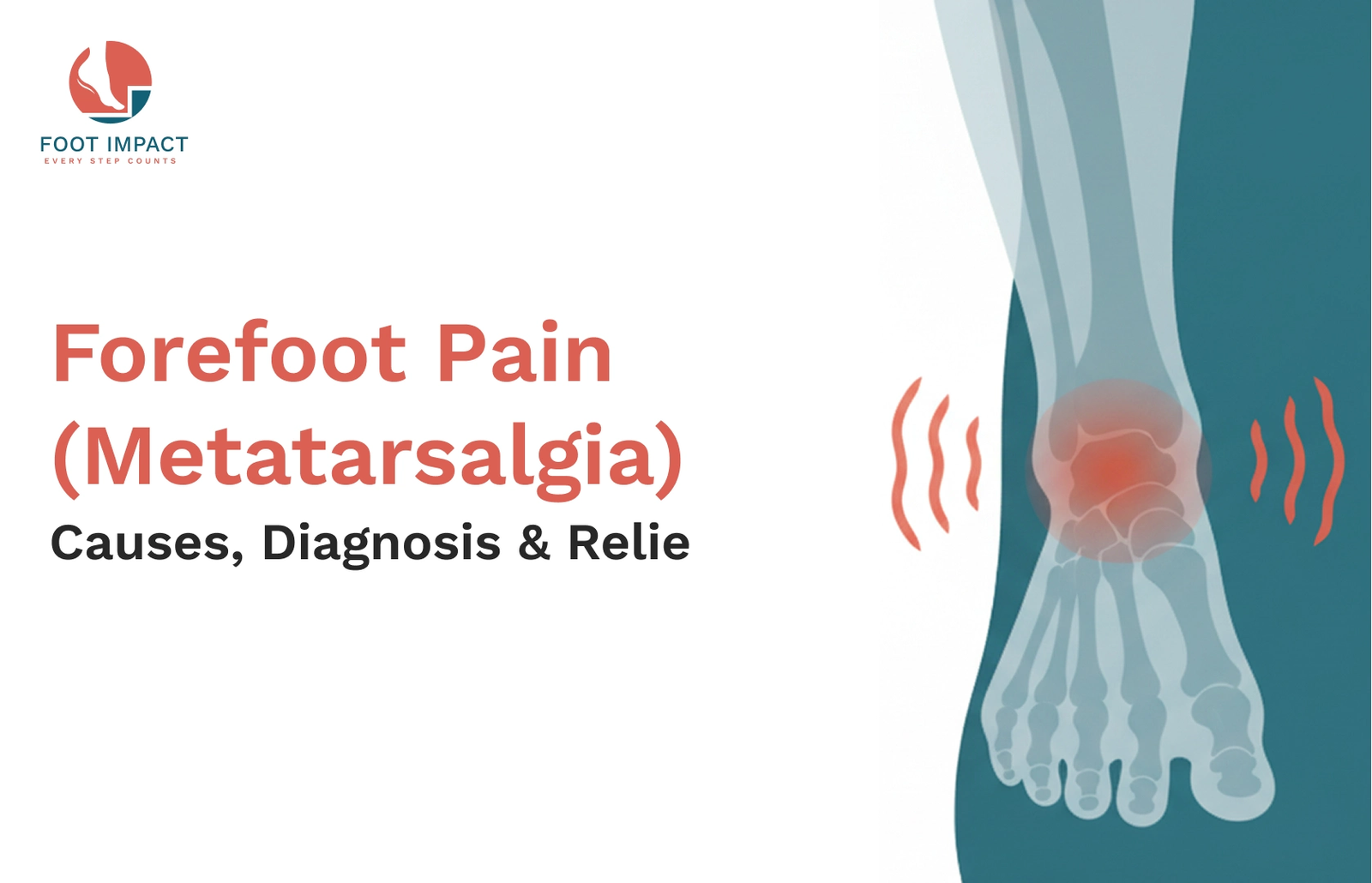
It often starts subtly — a faint burning sensation under the front of the foot after a long day, or a nagging ache that feels like you're walking with a pebble permanently lodged beneath your toes. Over time, that discomfort grows harder to ignore, and activities that were once effortless — a morning walk, a shopping trip, standing at a kitchen counter — begin to feel like a test of endurance. If this sounds familiar, you may be experiencing metatarsalgia, and forefoot pain metatarsalgia treatment in Mumbai is more accessible — and more effective — than many patients realise.
Metatarsalgia is not a diagnosis in the strict sense — it's a clinical term describing pain and inflammation in the metatarsal region, the area just behind the toes at the ball of the foot. It's one of the most common forefoot complaints seen in podiatry clinics, and yet it remains widely misunderstood, mismanaged, and — too often — simply endured.
This article explains the anatomy behind the pain, the conditions that commonly trigger it, how to distinguish metatarsalgia from other forefoot conditions, and what modern podiatric care can do to provide genuine, lasting relief.
What Is the Forefoot — and Why Is It So Vulnerable to Pain?
The forefoot comprises the five metatarsal bones and the fourteen toe bones (phalanges) that sit in front of them. Together, they form the front third of the foot — the part that bears the brunt of propulsion with every step. During normal walking, the body's full weight rolls forward across the metatarsal heads (the rounded ends of the metatarsal bones just behind the toes) before the toes push off the ground.
This means the metatarsal heads absorb enormous repetitive loads throughout the day. To distribute this force evenly, the forefoot relies on what's known as the transverse arch — a subtle but crucial curve that runs across the width of the foot just behind the toe joints. When this arch is maintained, pressure spreads across all five metatarsal heads relatively evenly. When it collapses or becomes overloaded, pressure concentrates on one or two heads, and pain follows.
That architectural vulnerability — compounded by poor footwear choices, structural foot types, weight, and activity levels — is why forefoot pain is so prevalent. And it's why treating it properly requires more than just rest.

Metatarsalgia Explained: The Overloaded Transverse Arch
Metatarsalgia — from the Latin metatarsus and the Greek algos (pain) — technically refers to pain arising from the metatarsal region. In clinical practice, it usually describes a pattern of inflammation and mechanical overloading at the metatarsal heads, particularly the second, third, and fourth (the central heads, which bear the most load during push-off).
What makes forefoot pain metatarsalgia treatment in Mumbai such a relevant topic is the range of factors driving it. This isn't a condition that affects only athletes or older adults — it cuts across age groups and activity levels, and it's frequently seen in people who spend long hours on their feet at work, those who've recently changed their exercise habits, and those whose foot structure predisposes them to forefoot overload.
The inflammation that develops at the metatarsal heads produces a characteristic set of sensations — burning, aching, and a sharp pain on weight-bearing that often feels like standing on a stone or marble. Symptoms are typically worst in thin-soled shoes, on hard floors, and toward the end of the day when cumulative load has built up.
What Triggers Metatarsalgia? The Most Common Causes
Metatarsalgia rarely has a single cause. More often, it reflects the convergence of several contributing factors — a particular foot type combined with unsuitable footwear and an increase in activity, for example. Understanding what's driving the pain in each individual case is essential to treating it effectively.
High Heels and Fashion Footwear
Heeled shoes fundamentally alter load distribution in the foot. By elevating the heel, they shift the body's weight forward onto the metatarsal heads — dramatically increasing forefoot pressure. Studies have shown that even a modest heel height of five centimetres can increase forefoot load by up to 75%. For regular heel wearers, this chronic overload is a primary driver of metatarsalgia. Narrow toe boxes compound the problem by compressing the forefoot and further destabilising the transverse arch.
Flat-Soled and Unsupportive Footwear
At the other extreme, completely flat footwear — thin ballet pumps, flip-flops, and certain trainers — offers no cushioning or arch support, leaving the metatarsal heads to absorb impact directly. This is particularly problematic for people with flat feet or high arches, whose forefoot mechanics are already compromised.
Flat Feet and Overpronation
When the foot overpronates — the arch collapses and the foot rolls inward — the mechanics of the forefoot are disrupted. The metatarsal bones splay apart, the transverse arch flattens, and load concentrates at the central metatarsal heads. Flat feet treatment that addresses the underlying arch collapse often produces significant improvement in forefoot pain as a secondary benefit.
High Arch (Cavus Foot)
A high arch creates a rigid, supinated foot that transfers weight predominantly to the heel and the outer metatarsal heads. Because the foot doesn't pronate sufficiently to absorb impact, the forefoot receives concentrated, unmodified load with every step. High arch patients are among the most likely to present with lateral forefoot pain and stress fractures.
Bodyweight and Activity Load
Increased body weight directly increases the load passing through the forefoot with every step. Similarly, sudden increases in activity — beginning a running programme, taking up a physically demanding job, or spending unusually long hours standing — can overwhelm the foot's load-bearing capacity before it has adapted, triggering acute metatarsalgia.
Foot Deformities and Toe Changes
Hallux valgus (bunion) — where the big toe drifts toward the lesser toes — significantly disrupts load distribution. The first metatarsal head, which normally bears a substantial share of forefoot pressure, loses its weight-bearing function as the bunion develops, offloading the excess onto the second and third metatarsal heads. Hammer toes and claw toes create similar imbalances.
How Metatarsalgia Feels: Recognising the Symptoms
The sensation of forefoot pain can vary — and recognising the specific character of your pain is useful both for self-awareness and for the clinical history you'll give your podiatrist. Common descriptions include:
A burning or sharp pain under the ball of the foot, typically worse when walking or standing
An aching sensation that builds over the course of the day and eases with rest
A feeling of walking on a pebble or marble — a tell-tale descriptor for metatarsal head inflammation
Numbness or tingling in the toes (which may suggest nerve involvement — see below)
Pain that is worse in thin-soled shoes and on hard surfaces
Visible callus formation under the affected metatarsal head, as the skin thickens in response to chronic pressure
The location of the pain offers useful diagnostic clues. Central forefoot pain (under the second and third metatarsals) most commonly reflects mechanical overload. Pain specifically under the first metatarsal head may involve the sesamoid bones. Pain between the third and fourth toes — particularly a shooting or electric quality — raises suspicion of Morton's neuroma rather than straightforward metatarsalgia.
Conditions Often Confused With Metatarsalgia
Metatarsalgia is a broad descriptor, not a specific diagnosis. Several distinct conditions produce forefoot pain that can look very similar on the surface — and getting the right diagnosis matters enormously, because the treatment for each differs significantly.
Morton's Neuroma
A Morton's neuroma is a thickening of the nerve tissue between the metatarsal heads — most commonly between the third and fourth metatarsals. It produces burning, shooting, or electric pain in the forefoot, often with the sensation that something is bunched up inside the shoe. Unlike mechanical metatarsalgia, Morton's neuroma typically worsens when the forefoot is squeezed laterally (pressing the metatarsal heads together) and may respond to nerve-specific treatments including corticosteroid injection or surgical decompression.
Metatarsal Stress Fracture
A stress fracture of the metatarsal — a hairline crack caused by repetitive loading — produces localised, point-specific tenderness over one metatarsal shaft, not just the head. It's common in runners, dancers, and military recruits. Stress fractures require confirmed diagnosis via imaging (MRI or bone scan, since they're often invisible on plain X-ray) and a period of offloading and rest.
Sesamoiditis
The sesamoids are two small bones embedded within the flexor tendon beneath the first metatarsal head — they act as a pulley for the big toe. Sesamoiditis describes inflammation or injury to these bones, producing pain specifically under the ball of the foot at the big toe side. It's particularly common in dancers, runners, and those who wear high heels regularly.
Freiberg's Disease
Freiberg's disease is an osteochondrosis (avascular necrosis) of the metatarsal head — most often the second. It affects adolescents and younger adults more commonly than older patients and presents with pain, swelling, and stiffness specifically at the affected metatarsal head joint. Imaging confirms the diagnosis.

How Podiatrists Diagnose Forefoot Pain and Metatarsalgia
Accurate diagnosis of forefoot pain requires more than a visual inspection and a symptom checklist. In a modern podiatry setting, several assessment tools work together to build a complete picture of what's happening biomechanically and structurally.
Pressure Mapping (Pedobarography)
Pressure mapping is one of the most valuable diagnostic tools for forefoot pain. By measuring the distribution of load across the plantar surface of the foot during standing and walking, it identifies which metatarsal heads are bearing excessive pressure — and by how much. This data directly informs the design of offloading orthotics, ensuring that pressure redistribution is targeted and evidence-based rather than approximate.
Gait Analysis
A comprehensive gait analysis assesses foot posture, pronation/supination pattern, push-off mechanics, and stride characteristics. For forefoot pain patients, it often reveals whether the pain is driven by a foot posture problem (flat feet, high arch), a footwear issue, a muscle weakness, or a combination of all three. Video gait analysis allows the podiatrist to demonstrate findings to the patient visually — which is particularly useful for understanding why specific footwear changes or orthotics are being recommended.
Clinical Examination
Hands-on examination includes palpating each metatarsal head to localise tenderness, testing range of motion at the metatarsophalangeal joints, performing the Morton's test (lateral compression of the forefoot) to screen for neuroma, and assessing skin changes including callus distribution. The pattern and location of callus formation often tells a clear biomechanical story.
Imaging When Indicated
Weight-bearing X-rays are useful for detecting metatarsal length discrepancies, joint changes, and bony pathology. MRI or diagnostic ultrasound may be ordered when a neuroma, stress fracture, or sesamoid injury is suspected clinically. Not all forefoot pain requires imaging — the clinical examination often provides sufficient diagnostic clarity.
Treatment Options for Forefoot Pain and Metatarsalgia
The good news about metatarsalgia is that the majority of cases respond well to conservative, non-surgical treatment — provided the right combination of interventions is selected based on the underlying cause. Here's what modern podiatric management involves.
Metatarsal Offloading Orthotics
This is the most impactful intervention for most metatarsalgia patients. Custom offloading orthotics are designed with a metatarsal pad or dome — a specifically positioned raise placed just proximal to (behind) the metatarsal heads. This pad deflects load away from the inflamed heads and redistributes it across the metatarsal shafts, which are far better equipped to handle it. The result is often a significant, immediate reduction in pain. Unlike generic insoles from a pharmacy, custom orthotics are fabricated to match the exact geometry of the patient's foot and are positioned based on pressure mapping data — making them substantially more effective.
Footwear Modification
For many patients, footwear change alone produces meaningful relief. Key recommendations typically include transitioning to shoes with a wider toe box (to reduce forefoot compression), a rocker-bottom sole (which reduces the force at push-off), adequate cushioning in the forefoot region, and — critically — eliminating or significantly reducing heel height. Your podiatrist can advise on specific brands and styles suited to your foot type and metatarsalgia pattern.
Strengthening and Rehabilitation Exercises
Weakness of the intrinsic foot muscles — the small muscles within the foot that support the transverse arch — is a frequently overlooked contributor to metatarsalgia. A targeted exercise programme including toe-spreading exercises, towel scrunches, short-foot exercises, and calf strengthening can improve forefoot mechanics and reduce susceptibility to overload over time.
Activity Modification and Load Management
During the acute phase, reducing activities that place high impact on the forefoot — running on hard surfaces, standing for extended periods in thin-soled shoes — gives the inflamed tissue time to settle. This is temporary, not permanent. The goal of load management is to allow tissue recovery while the mechanical cause is being addressed, not to eliminate activity indefinitely.
Padding and Strapping
For immediate symptomatic relief, felt metatarsal padding or therapeutic forefoot strapping can offload the affected area quickly. These are particularly useful in the short term, while custom orthotics are being fabricated.
Corticosteroid Injection
Where significant capsular inflammation is present at a metatarsophalangeal joint, a carefully placed corticosteroid injection can provide rapid pain relief. This is used selectively, as a complement to mechanical management rather than a standalone treatment — the inflammation will return if the underlying mechanical cause is not addressed.
Summary: Forefoot Pain Treatment Approaches at a Glance
How Foot Impact Approaches Forefoot Pain in Mumbai
At Foot Impact, we see a significant number of patients who have been living with ball of foot pain for months — sometimes years — having tried generic insoles, changed their shoes repeatedly, or simply hoped the pain would pass. In most cases, a clear biomechanical cause is identifiable within the first assessment.
Our approach to forefoot pain metatarsalgia treatment in Mumbai combines digital pressure mapping, video gait analysis, and detailed clinical examination to produce a diagnosis grounded in objective data. From there, we design a treatment plan that addresses the actual mechanical driver — not just the symptom. Custom metatarsal offloading orthotics are fabricated in-house, allowing us to refine the design based on patient feedback and follow-up pressure mapping where needed.
We also work closely with patients on footwear — a part of treatment that is often underestimated. The best orthotics in the wrong shoe will underperform. Getting both right, together, is what produces lasting results.
Frequently Asked Questions About Forefoot Pain and Metatarsalgia
What does metatarsalgia feel like?
Metatarsalgia typically produces burning, aching, or sharp pain under the ball of the foot, often described as walking on a pebble or marble. Pain is usually worst in thin-soled shoes, on hard surfaces, and after prolonged standing or walking. It tends to ease with rest.
What causes pain under the toes and ball of the foot?
Pain under the toes and ball of the foot (the metatarsal region) is most commonly caused by mechanical overloading of the metatarsal heads. Contributing factors include high heels, flat or unsupportive footwear, flat feet or overpronation, high arch, increased body weight, and toe deformities such as bunions or hammer toes.
How is metatarsalgia different from Morton's neuroma?
Both conditions cause forefoot pain, but they have different mechanisms. Metatarsalgia involves inflammation and overloading of the metatarsal heads. Morton's neuroma is a thickening of the nerve tissue between metatarsal heads, producing burning, shooting, or electric pain — often specifically between the third and fourth toes. A podiatrist can distinguish between them through clinical examination and, if needed, ultrasound imaging.
Can custom orthotics help with forefoot pain?
Yes — custom metatarsal offloading orthotics are one of the most effective treatments for metatarsalgia. They are designed with a metatarsal pad positioned behind the affected heads, redistributing pressure away from the inflamed area. Because they are fabricated to each patient's individual foot, they offer significantly better results than over-the-counter insoles.
Where can I find metatarsalgia treatment in Mumbai?
Foot Impact in Mumbai provides specialist forefoot pain assessment and metatarsalgia treatment using digital pressure mapping, gait analysis, and custom offloading orthotics. Our podiatry team develops personalised treatment plans based on the specific mechanical and structural cause of each patient's forefoot pain.
Is forefoot pain metatarsalgia a serious condition?
Metatarsalgia is not dangerous in the way serious medical conditions are, but it can be significantly disabling and tends to worsen if the underlying mechanical cause is not addressed. Left untreated, it can alter gait patterns in ways that create secondary problems in the knees, hips, and lower back. Early treatment produces faster and more complete resolution.
Can I treat metatarsalgia without surgery?
In the vast majority of cases, yes. Most patients with metatarsalgia respond well to conservative management including custom orthotics, appropriate footwear, strengthening exercises, and load modification. Surgery is rarely needed and is only considered when structural issues — such as a metatarsal length discrepancy — do not respond to all conservative measures.
Conclusion: Ball of Foot Pain Is Treatable — With the Right Approach
Forefoot pain and metatarsalgia are among the most common — and most underestimated — foot conditions that people simply push through. The burning, the aching, the pebble-in-the-shoe feeling that makes a normal walk feel like a small ordeal: none of it is something you need to accept as a permanent feature of life.
Forefoot pain metatarsalgia treatment in Mumbai, done properly, begins with understanding exactly where the excess load is going and why. It continues with a targeted mechanical response — orthotics designed to redirect that load, footwear appropriate for the foot type, and exercises that build the internal support the foot needs. When those elements align, patients frequently describe the improvement as transformative.
If you're dealing with persistent ball of foot pain in Mumbai and want a clear, evidence-based diagnosis and treatment plan, explore our forefoot and metatarsalgia treatment services. You can also learn more about how custom metatarsal offloading orthotics work, understand the connection between flat feet and forefoot overload, or find out what a comprehensive gait analysis can reveal about your foot mechanics.
Forefoot pain has a cause. That cause has a treatment. It starts with the right assessment.