Bunion Treatment in Mumbai — Causes, Symptoms & Non-Surgical Options | Foot Impact
A bunion starts small. A slight bump at the base of your big toe, a bit of redness after a long day, shoes that used to fit fine now feeling uncomfortably tight. Most people ignore it at this stage — and that's exactly when it's easiest to manage.
By the time bunion pain is affecting your daily walk, your choice of footwear, or your ability to stand for long periods at work, the joint has already shifted significantly. The good news is that the majority of bunion cases — even moderate ones — can be managed effectively without surgery, provided the right approach is taken early enough.
At Foot Impact, our podiatrists in Mumbai assess bunions not just as a bony bump but as a biomechanical problem with a root cause. This guide explains what bunions are, why they develop, what the symptoms look like at each stage, and how a podiatric approach to treatment differs from simply buying wider shoes and hoping for the best.
What Is a Bunion — and What Is Actually Happening Inside Your Foot?
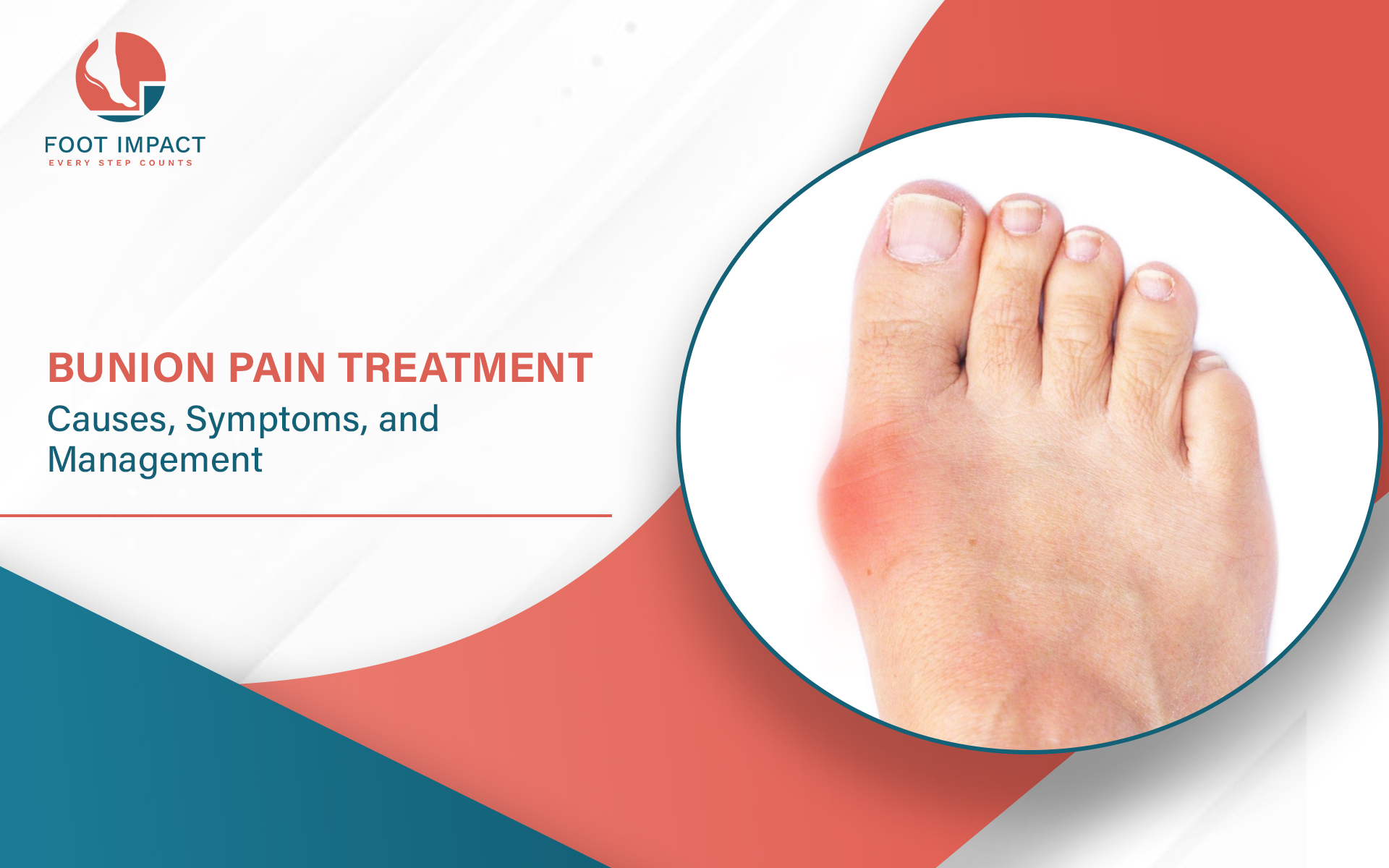
The medical term for a bunion is hallux valgus — a Latin phrase that essentially means the big toe is deviating outward. What you see on the outside as a bony bump is actually the head of the first metatarsal bone being pushed inward while the big toe angles toward the second toe.
It is not a growth or a new bone. It is a structural misalignment of the first metatarsophalangeal joint — the joint at the base of the big toe — that progressively worsens as the forces of walking continue to act on an already displaced joint.
As the misalignment increases, several things happen simultaneously:
- The joint capsule on the inner side stretches and weakens
- The tendons that should pull the big toe straight begin pulling it at an angle instead, accelerating the deformity
- The bursa — a fluid-filled sac cushioning the joint — becomes chronically inflamed, producing the characteristic redness and swelling
- Pressure and friction from footwear causes the skin over the joint to thicken into a callus
- The second toe, now being pushed by the angling big toe, may begin to develop its own problems — a hammertoe or crossover toe
Understanding this progression matters because it explains why bunions do not stay the same. Without intervention, the forces acting on the joint continue working in the wrong direction every time you take a step.
What Causes Bunions?
Bunions are not caused by a single factor — they develop from a combination of structural predisposition, biomechanical loading, and lifestyle influences. Understanding your specific drivers is the first step toward managing progression.
Foot Structure and Inherited Biomechanics
This is the most significant factor for most patients. Certain foot types are inherently more likely to develop bunions — particularly flat feet and feet with a long first metatarsal bone. If one or both of your parents had bunions, the likelihood of you developing them is substantially higher — not because bunions themselves are inherited, but because the underlying foot structure that predisposes to them is.
Flat feet and overpronation are particularly important here. When the arch collapses with each step, the foot rolls inward and the big toe joint absorbs a rotational force it was not designed to sustain. Over years of walking, this cumulative mechanical stress gradually shifts the joint out of alignment.
Footwear — a Contributing Factor, Not the Sole Cause
The role of footwear is frequently overstated. Tight, narrow, or high-heeled shoes do not cause bunions in people with normal foot biomechanics — but in people with a structural predisposition, they dramatically accelerate the progression. Pointed toe boxes force the toes into an already misaligned position repeatedly. High heels shift body weight forward onto the ball of the foot, increasing pressure on the first metatarsal joint with every step.
For women in professional environments in Mumbai who spend long hours in formal footwear, this is a significant driver of accelerated bunion development.
Hypermobility and Joint Laxity
Some individuals have naturally looser joints and ligaments — a condition called hypermobility. In the foot, this means the joints are less stable under load, making the first metatarsal more susceptible to drifting out of alignment over time.
Inflammatory Arthritis
Conditions like rheumatoid arthritis directly affect joint health and can cause or accelerate bunion formation. If your bunion developed relatively quickly, is associated with pain in multiple joints, or is accompanied by morning stiffness, an inflammatory condition should be evaluated and ruled out.
Recognising Bunion Symptoms — and Understanding Which Stage You're At
Bunion symptoms progress through stages. The stage you're at determines both the most appropriate treatment and the urgency of intervention.
Early Stage
- A visible but small bump at the base of the big toe
- Occasional mild aching after long walks or a day in tight shoes
- Slight redness over the joint after activity
- The big toe still has normal or near-normal range of motion
- No significant pain at rest
At this stage, conservative management is highly effective and surgery is almost never indicated.
Moderate Stage
- The bump is more prominent and consistently visible
- Pain is more frequent — during activity, after standing for long periods, and sometimes at rest
- The big toe is visibly angled toward the second toe
- Reduced range of motion in the big toe joint
- Skin over the bunion is thickened or calloused
- Finding comfortable shoes has become genuinely difficult
- The second toe may be starting to be pushed upward or sideways
At this stage, conservative management can still achieve significant symptom control and slow or halt progression — but the window for easy management is narrowing.
Severe Stage
- Significant joint deformity — the big toe may be crossing over or under the second toe
- Constant pain that affects walking, standing, and sleep
- The joint may feel stiff and grinding with movement
- Secondary problems in the second and third toes
- Severe restriction of footwear options
- Daily activities and quality of life are meaningfully affected
At this stage, surgical consultation is appropriate — though even here, a podiatric assessment should precede any surgical decision, as many patients find conservative management provides sufficient relief to avoid or significantly delay surgery.
Bunion Treatment Without Surgery — What Actually Works
The majority of people with bunions — including many with moderate deformities — achieve meaningful, lasting relief through conservative podiatric management. Here is what that actually involves at Foot Impact.
Computerised Gait and Pressure Analysis
This is where bunion management at Foot Impact begins — and it is what separates a podiatric approach from simply buying bunion pads at a pharmacy.
A computerised foot pressure scan maps exactly how your foot is loading with every step — which areas are bearing excessive force, how your arch is behaving dynamically, and whether overpronation or other biomechanical patterns are driving your bunion progression. Without this data, any treatment is a guess.
Understanding your specific loading pattern tells us whether custom orthotics will be effective, what type of orthotic correction is needed, and whether your current footwear is actively worsening the joint position with every step you take.
Custom Orthotics — the Cornerstone of Conservative Management
For biomechanically driven bunions — which is the majority of cases — custom foot orthotics are the single most effective conservative intervention available. A correctly prescribed orthotic does not reverse an existing deformity, but it does two critical things: it controls the excessive pronation or first ray hypermobility that is driving progression, and it offloads the first metatarsophalangeal joint to reduce the forces accelerating the misalignment.
Generic insoles from a pharmacy are not the same thing. Custom orthotics at Foot Impact are designed from your individual pressure mapping data, built for your specific foot structure, and prescribed as part of a comprehensive biomechanical plan — not sold off a shelf.
Patients who wear properly prescribed custom orthotics consistently report reduced pain, improved comfort in daily footwear, and — critically — slowed or halted bunion progression when treatment begins at an early or moderate stage.
Footwear Guidance — Specific, Not Generic
Every podiatrist will tell you to wear wider shoes. What they don't always tell you is which specific features matter, why they matter for your particular foot type, and how to balance footwear function with the reality of professional or social life in Mumbai.
At Foot Impact, footwear guidance is individualised. For someone with flat feet driving their bunion, a motion-control shoe with a firm medial post is a fundamentally different recommendation from what suits someone with a high arch and a rigid first ray. We also work with patients whose occupational demands make standard footwear advice impractical — and find solutions that are genuinely achievable rather than theoretically ideal.
Toe Spacers, Splints, and Padding
Toe spacers worn during activity gently encourage better big toe alignment and reduce the compressive forces at the joint. Night splints — worn while sleeping — help maintain stretch in the medial soft tissues and slow the progressive tightening that pulls the toe further out of alignment over time.
These are adjuncts, not standalone treatments. Used alongside custom orthotics and footwear correction, they contribute meaningfully to managing symptoms and slowing progression.
Targeted Exercise and Strengthening
The muscles and tendons around the first metatarsophalangeal joint play an active role in joint stability. When the joint drifts out of alignment, these structures begin functioning at mechanical disadvantage — which further accelerates the problem.
A structured exercise programme targeting the intrinsic foot muscles, the flexor hallucis longus, and the calf and arch musculature helps restore some degree of active joint control. These exercises won't reverse a bunion, but they reduce pain, improve function, and slow progression — particularly in early and moderate stage presentations.
When Is Surgery Actually Necessary?
This is one of the most common questions we are asked at Foot Impact — and the honest answer is: less often than many people assume.
Bunion surgery (osteotomy, bunionectomy, or arthrodesis depending on the severity and joint involvement) is genuinely indicated when:
- Conservative management has been properly tried — with correctly prescribed orthotics, appropriate footwear, and consistent follow-through — and has not provided adequate pain relief
- The deformity is severe enough that daily function is significantly and persistently impaired
- Secondary joint damage (arthritis within the first MTP joint) is confirmed on imaging
- The second or third toes are developing fixed deformities as a result of the bunion
What surgery does not do is address the underlying biomechanical cause. A patient who has a bunion corrected surgically and then returns to the same footwear and the same biomechanical loading pattern has a meaningful risk of recurrence. This is why post-surgical orthotic use is strongly recommended — and why a pre-surgical podiatric assessment often changes the treatment pathway entirely.
If you have been told you need surgery, a podiatric assessment at Foot Impact before proceeding is a worthwhile step. Not to avoid surgery if it is genuinely needed — but to ensure conservative options have been properly explored and to optimise your post-surgical outcome if surgery does go ahead.
Bunion Management at Foot Impact — What to Expect
When you come to Foot Impact in Andheri West or Khar West, Mumbai with bunion pain, here is what your assessment involves:
Step 1 — Clinical History: How long has the bunion been present, how has it changed, what makes it worse, what footwear you currently wear, and your occupational demands — all documented in detail.
Step 2 — Physical Examination: Assessment of big toe joint range of motion, joint stability, degree of deformity, skin and soft tissue changes, and the relationship between your bunion and your overall lower limb alignment.
Step 3 — Computerised Pressure and Gait Analysis: Real-time foot pressure mapping identifies your specific biomechanical drivers. This is the data that guides your orthotic prescription.
Step 4 — Footwear Assessment: Your current footwear is reviewed for suitability. The wrong shoes can undo the benefits of even well-prescribed orthotics.
Step 5 — Personalised Treatment Plan: Based on your stage, your biomechanics, and your daily demands, a specific treatment plan is built — including custom orthotic prescription, footwear guidance, exercise programme, and follow-up schedule.
👉 Book Your Bunion Assessment at Foot Impact, Mumbai →
Preventing Bunion Progression — Practical Steps
If you have a bunion or a family history of them, these steps meaningfully reduce your risk of progression:
- Choose shoes with a wide, rounded toe box — the toes should never be compressed together
- Avoid pointed-toe footwear and high heels for prolonged daily wear
- If you have flat feet or overpronate, wear prescribed orthotics consistently — not only when pain is active
- Perform daily foot and toe strengthening exercises — particularly if you spend long hours standing
- Replace athletic footwear every 500–600 km — worn midsoles no longer provide adequate support for the first metatarsal joint
- If you notice the bump growing or pain increasing, seek podiatric assessment early — the earlier the intervention, the better the outcome
Frequently Asked Questions About Bunions
Q1. Can a bunion go away on its own? No — a bunion is a structural joint misalignment and will not correct itself without intervention. What conservative treatment achieves is slowing or halting progression and managing pain effectively — not reversing the existing deformity. In some early-stage cases with the right orthotics and footwear, the joint position can marginally improve, but the primary goal of non-surgical management is stability and comfort, not reversal.
Q2. How do I know if I need bunion surgery or if conservative treatment will work? In most early and moderate stage bunions, conservative management with custom orthotics, appropriate footwear, and a structured exercise programme provides meaningful pain relief and slows progression significantly. Surgery becomes the right conversation when conservative management has been properly tried and has not achieved adequate function. A podiatric assessment at Foot Impact will give you a clear picture of which stage you are at and what the realistic expectations of each treatment pathway are.
Q3. My bunion doesn't hurt much — should I still get it assessed? Yes — and ideally sooner rather than later. Pain is a late signal in bunion progression. The structural changes in the joint happen gradually over years, often with minimal discomfort in the early stages. By the time pain becomes significant, the deformity is often moderate to severe. An early assessment allows for intervention that genuinely prevents progression, rather than managing a problem that has already become established.
Q4. Will wearing bunion pads or toe spacers from the pharmacy fix my bunion? Pharmacy bunion pads and spacers provide symptomatic relief — cushioning the joint from shoe friction and gently encouraging better toe alignment. They are useful adjuncts but do not address the underlying biomechanical drivers of the bunion. Without correcting the loading pattern that is driving the misalignment, the joint continues shifting regardless of what is placed around it. Custom orthotics prescribed from pressure mapping data are a fundamentally different and more effective intervention.
Q5. Is bunion treatment at a podiatry clinic in Mumbai covered by insurance? This depends on your specific insurance policy and provider. Custom orthotics and podiatric consultation are covered under some health insurance plans in India, particularly those with broader allied health or specialist provisions. We recommend checking with your insurer directly. Foot Impact can provide documentation of your diagnosis and treatment plan to support any insurance claims.
Q6. How long does it take to see improvement with conservative bunion treatment? Most patients notice meaningful pain reduction within 4–6 weeks of wearing correctly prescribed custom orthotics and modifying footwear. Slowing of bunion progression — which is measured by monitoring the hallux valgus angle over time — is assessed at follow-up appointments, typically at 3 and 6 months. The key variable is consistency: orthotics worn inconsistently produce inconsistent results.
Conclusion — Act Early, Avoid Surgery
The single most important thing to understand about bunions is that they respond best to early intervention. The biomechanical forces driving the misalignment work continuously — every step, every day. Starting the right treatment early means those forces are controlled before the joint has shifted significantly. Waiting until pain becomes severe means managing a more advanced structural problem with fewer conservative options.
At Foot Impact, we see patients at every stage of bunion progression — from a first-time visit after noticing a small bump, to patients who have been told they need surgery and want a second opinion. In the majority of cases, a properly structured conservative programme achieves outcomes that genuinely satisfy patients — less pain, more comfortable footwear, and the confidence that the problem is being properly managed.
If your bunion has been bothering you — even mildly — it is worth getting it properly assessed now rather than later.
Book your bunion assessment at Foot Impact, Andheri West, Mumbai →